Showing posts with label Community. Show all posts

Monday, March 7, 2011

C-28: How the anti-spam bill may effect your business

David Canton of Harrison Pensa is a lawyer specializing in electronic law. He recently wrote an article for the London Free Press (and also found on his blog) where he brings our attention to some potential problems that businesses large and small will face under the new laws aimed at reducing spam:

The anti-spam bill was recently passed [David Sanders: Bill C-28 is here in Bill form, and the final version is here on the federal e-law site), and here is a one-page HTML version on Canlii], and will be in force this year. It gives new tools to fight spam, but unfortunately defines spam so broadly that it will affect how most organizations conduct business.

Businesses can’t just ignore the legislation. Remedies include fines of up to $1 million for individuals, $10 million for others […]

An e-mail to just one person you met at an event who you consider a potential customer may be considered spam [and] “electronic message” is broadly defined […]

Messages will not be considered spam if the recipient has consented to receiving the message. But it is up to the sender to show the recipient has consented if there is a complaint [...]"
and what constitutes "consent" is a complicated thing. David Canton strongly recommends that all businesses and charities review the consent provisions to determine if their electronic communication policies need to change.

The Act also links consent to purpose:
since my e-mail address is published on my firm’s website and other places, you may be able to e-mail me with anything relevant to the practice of law — but you won’t be able to e-mail me trying to sell me a trip. If I hand you my business card, the same applies.

Canton correctly notes that -- as with many pieces of legislation -- the devil will be in the details of the regulations that the legislature and bureaucracy will create to implement and enforce this Act, and those regulations haven't been published yet.

To keep tabs on e-law issues, keep an eye on David Canton’s blog on the topic.

Saturday, April 24, 2010

Henson Trusts

A Henson trust (sometimes called an absolute discretionary trust) is one designed to benefit disabled persons by protecting ensuring that the assets of a disabled person can still be used to their benefit without compromising their right to collect government benefits and entitlements. This is done by ensuring that the trustee’s discretion in the operation of the trust is absolute, even to the extent of whether or not the trust assets are used (and, if used, to what extent) to provide assistance to the beneficiary. Such a power means that the assets do not vest with the beneficiary and thus cannot be used to deny means-tested government benefits. There are also possible income tax relief elements because of taxation at a lower marginal rate. They are also sometimes used to shield assets from matrimonial division in case of divorce of the beneficiary. In most cases, the trust assets are immune from claims by creditors of the beneficiary. Henson trusts can operate as either living trusts (i.e. for the benefit of the beneficiary when you are still alive) or as a testamentary trust (i.e. for the benefit of the beneficiary after your death).

Further information can be found in this paper:
"What Can You Do To Enhance The Quality of Life For a Family Member with a Disability: Consider a Henson Trust",
a document produced by Reena, (“a non-profit social service agency dedicated to integrating adults with developmental disabilities into the mainstream of society”) and The Law Foundation of Ontario:
"What Can You Do To Enhance The Quality of Life For a Family Member with a Disability: Consider a Henson Trust".
a document produced by Reena, (“a non-profit social service agency dedicated to integrating adults with developmental disabilities into the mainstream of society”) and The Law Foundation of Ontario:
Henson Trust

Thursday, February 18, 2010

A non-profit board risk management checklist

Sitting on a non-profit board: A risk management checklist for lawyers
© 2010 Lawyers’ Professional Indemnity Company.

Serving as a director of a charitable or not-for-profit corporation can be a rewarding but potentially risky experience. A director can be held personally liable for his or her own actions or failures to act, as well as jointly and severally liable with the other members of the board of directors.
Directors with specialized knowledge and expertise, such as lawyers, are held to a higher standard of care. LAWPRO’s standard professional liability insurance policy provides coverage only for the “professional services” that a lawyer provides as a lawyer. It does not provide coverage for liability arising as a result of a lawyer’s actions as a director.

Accordingly, here are some questions you should ask yourself before serving as a director on the board of a charity or not-for-profit organization.

1. How well do I know this organization? Does it engage in activities that have an especially high risk of attracting legal liability?

2. What are my motivations for joining this board – business, personal, community service, etc.?

3. Will I be able to devote my time and energy to ensure that I fully meet my obligations in this role?

4. Do I understand the risks and responsibilities that come with directorship? Am I aware of the statutory and common law liabilities that I may be exposed to?

5. Does my firm have a policy regarding its lawyers serving on the boards of charities and not-for-profits?

6. Is the charity or not-for-profit organization a client of my firm? If so, does my firm have a policy regarding its lawyers serving on the boards of charities and not-for-profits that are clients of the firm?

7. Will the charity or not-for-profit organization agree to indemnify me for liability arising out of my role as director?

8. Does the charity or not-for-profit organization maintain directors and officers (D&O) insurance to protect me from personal liability arising out of my role as director?

9. If so, what are the details of this D&O insurance? What policy terms, conditions and exclusions are likely to apply? What are the limits of liability per claim and in the aggregate?

10. Is there an outside director liability (ODL) insurance policy in place that may respond to claims against me arising out of my directorship? If not, should I purchase such insurance, whether from the Canadian Bar Insurance Association (CBIA) or through my insurance broker?

11. Is there any other insurance in place or optional coverage that may be purchased that may cover my activities as director? Have I consulted my insurance broker? (Note: LAWPRO’s optional excess insurance policy does not provide incidental D&O coverage, but some excess professional liability insurance policies may do so. If so, does that coverage “drop down” to afford primary protection?)

Friday, October 30, 2009

Some essential sources for directors of non-profits

Building a new not-for-profit organization: How to approach risk management. (HTML)
Paulette VinetteBy Paulette Vinette, CAE

Organization and Management of Nonprofits.
Charity Village (assorted authors)

Governance DO'S & DON'TS: Lessons from Case Studies on Twenty Canadian Non-profits. (PDF)
Mel Gill

Primer for Directors of Not for Profit Corporations (online HTML version).
Primer for Directors of Not for Profit Corporations (PDF version).
Co-ordinating Editor: Peter Broder. Text Editor: Norah McClintock. Contributors: Wayne Amundson; Jane Burke-Robertson; Terrance Carter; Jacqueline Connor; Paul Martel; David Stevens.

Wednesday, April 22, 2009

Missing Child: The suspect looks like this


"The composite drawing of a female suspect, said to be 19 to 25 years old, about 5 foot 1 and some 125 pounds, that was released last night is based on a description provided by an "independent witness," police said this morning."
(Toronto Star)

Victoria "Tori" Stafford is 8 years old and resides in Woodstock. Victoria attended school at Oliver Stephen's Public School in Woodstock, and left school when dismissed at 3:25 PM. Victoria had invited two friends to her house to watch a movie after school, and she was seen leaving the school. A video tape shows Victoria walking northbound on Fyfe Street in Woodstock with a white female. The time on the videotape is 3:32 PM. The female is wearing a white, waist length winter coat and may be carrying a black bag. The video shows Victoria and the female cross the street and continue walking east at the intersection of Walter Street.

Victoria was wearing black and white running shoes, black leotards, a black velvet pleated skirt, an army green coloured "Hanna Montana" T-shirt that had pink stitching with a hood, a black "Hanna Montana" winter coat with a hood trimmed with white fur, a black head hand, and butterfly earings. She was carrying a purple coloured "Bratz" bag.
OPP Website on the Victoria "Tori" Stafford disappearance.

If you have any information, please call the OPP at 1-877-9FIND ME (1-877-934-6363) Toll Free in Canada or email them at Tips or at opp.isb.resolve@ontario.ca, or call (705) 330-4144 for local or outside of Canada.

Sunday, February 22, 2009

PILLAR's Power of Philanthropy Conference - April 5, 2007

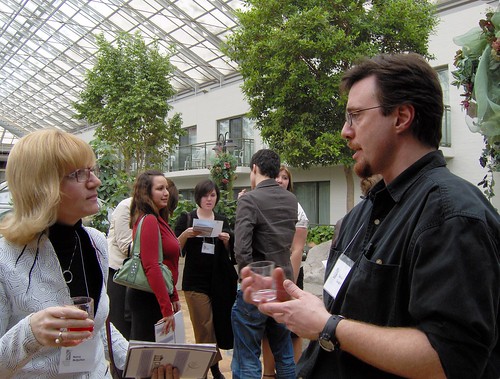
David Sanders (me!) at Pillar's Power of Philanthropy Conference, April 5, 2007. At left is Nancy McQuillan, Executive Director of the London Employment Help Centre. I am a member of the Board of LEHC (formerly LUHC), but at the time that the picture was taken I was the Strategic Planner on staff. I have since moved back to the Board but retain involvement in LEHC's exciting strategic planning process. The ongoing success of this organization is due in very large measure to Nancy and to its fantastic staff. It has been and continues to be a pleasure to be a contributing part of that team.